Mother – Daughter Duo Talk About Heart on the Hill
December, 4 2025
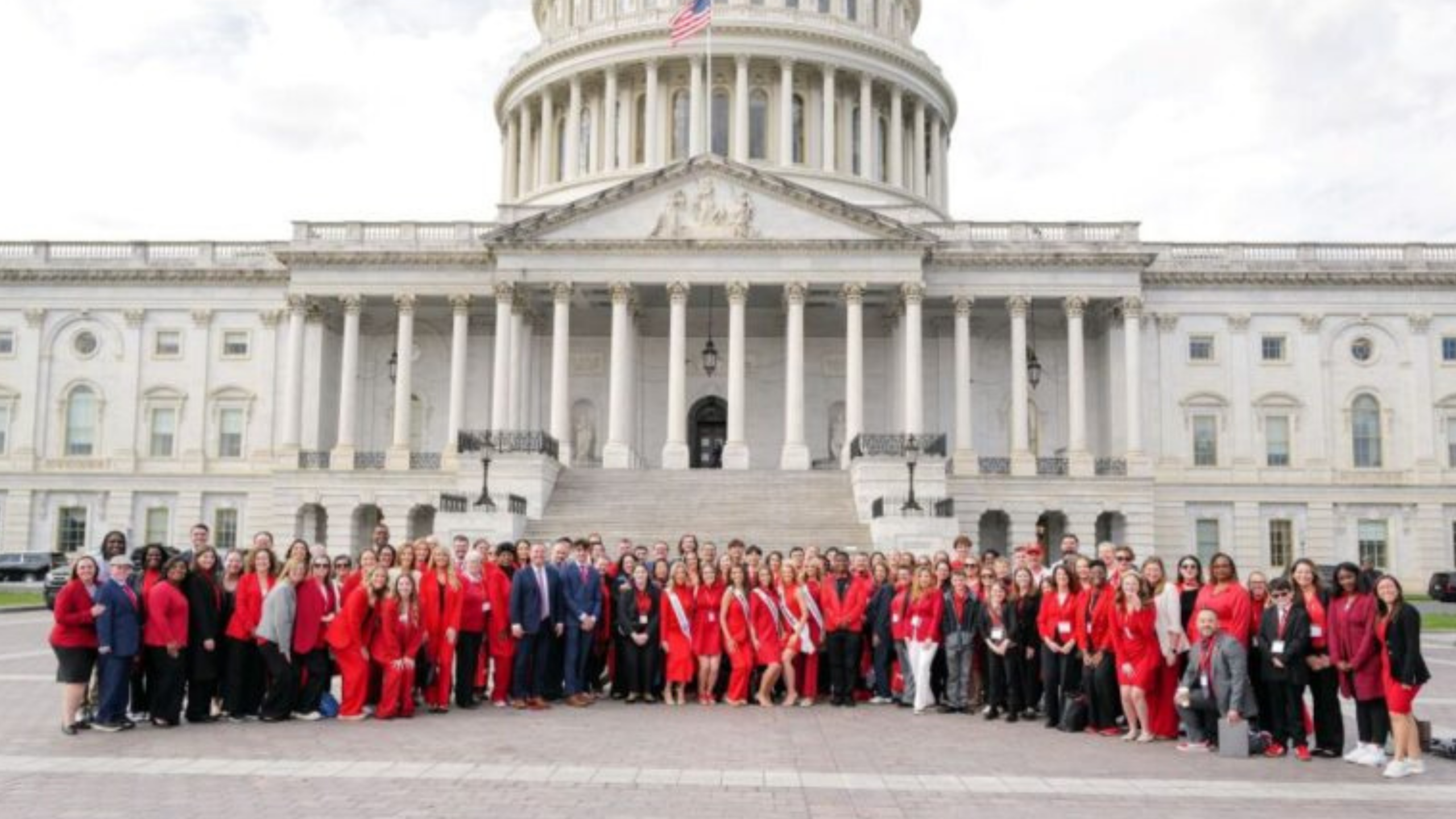
On October 28th, a delegation of nearly 150 American Heart Association (AHA) advocates from 47 states convened in Washington, DC to ask elected representatives to fund the bipartisan HEARTS Act, which was signed into law in December 2024 to improve the outcomes from sudden cardiac arrest. Each year, more than 356,000 Americans experience a sudden cardiac arrest outside of a hospital and 23,000 of these are children. Fewer than 10% of victims survive, and that is largely because only 40% receive the immediate help from bystanders they need before professional help arrives. When a person has a cardiac arrest, survival depends on immediately receiving CPR and shocks from an automated external defibrillator (AED). Waiting for an ambulance to arrive is not a solution since the survival rate from a sudden cardiac arrest decreases by 10% for every minute without CPR and defibrillation. By the time an ambulance arrives, the victim’s chance of survival has almost run out. Bystanders must act quickly for the victim to beat the odds.
Schools are a cornerstone of local communities because they are places where youth and families spend large amounts of time. Due to this deep impact, the AHA strongly supported the HEARTS Act, which created a grant program that would give schools money to fund CPR and AED training for students, faculty, staff, coaches and volunteers, to purchase new or replace outdated AEDs, and to develop cardiac emergency response plans (CERPs) that set steps to take during a cardiac emergency. Children who experience cardiac arrests in schools with AEDs are seven times more likely to survive. Having a CERP, which is like a fire safety plan, more than doubles survival rates for cardiac arrests in schools. Also, CPR and AED skills learned in schools help create a network of prepared citizens to assist whenever and wherever cardiac emergencies occur, including at sporting events, in the community, and at home. These skills learned at school can impact life both inside and outside school walls by turning bystanders into rescuers.
The Why, Rebecca Scott
 My younger daughter, Charlotte, and I traveled to Capitol Hill in October as part of this AHA delegation for very personal reasons. Six years ago, I suffered a sudden
cardiac arrest on the tennis court while playing with my older daughter, Abby. Although I had never experienced any cardiac symptoms in the past, that day my heart rate quickly raced from a comfortable level to nearly 220 beats per minute . . . then stopped. There was no warning. I never complained of a single symptom. I just suddenly fell to the ground without a sound. It was as if a switch flipped, and I went down.
Abby, who was 13 at the time, was not trained to perform CPR or use an AED. Fortunately, five trained bystanders immediately stepped in. Their prompt action, followed by care from an emergency medical response team that arrived by ambulance, restarted my heart. My recovery was not easy, but I am lucky to count myself in the company of the fewer than 5% of cardiac arrest victims in Massachusetts who survive. We now know that a genetic heart condition which runs in our family caused my heart to stop that day.
To make sense of this tremendous gift of life, my family has become vigorously committed to CPR and AED advocacy. As part of this work, Abby and I traveled to Washington in May 2024 as part of the original delegation that helped push for the passage of the HEARTS Act. For months afterwards, we waited anxiously for news that Congress would vote on the legislation. We were overjoyed when it unanimously passed the House in September but began to despair when the Senate did not act before the federal elections took place in November. A final flurry of advocacy in December got us up and over the hurdle. On the evening of December 10th, the Senate unanimously passed the HEARTS Act. Just a few days later, we cried tears of joy when President Biden signed it into law as one of his last acts in office. It felt like a huge victory and the culmination so much hard work.
Getting a law on the books is one thing. Ensuring that federal funding and oversight exists to make its programs a reality is another. Even though both Houses of Congress unanimously passed the HEARTS Act, funding has been tied up in the government shutdown and partisan stalemate. When the AHA solicited volunteers for a second delegation to lobby at the Capitol this October, we did not hesitate. We wanted to do all we could to ensure that the HEARTS Act can have the impact Congress intended when they voted for it unanimously.
The Work, by Charlotte Scott
 I was only 10 when my mother had her cardiac arrest, but the experience deeply impacted me. It has sparked my interest in heart health and desire to ensure that students like me are trained to respond in the case of emergency. I cannot imagine what would have happened that day if Abby had been alone with my mom since she did not know how to recognize a cardiac arrest, how to perform CPR, or how to use an AED. She might have called 911, but it would have probably been too late by the time the ambulance arrived.
I am a junior in high school now and I have been trained and certified multiple times to perform CPR and use an AED. I have also become involved with the AHA to improve preparedness for students like me. It was an amazing experience to make this trip to Washington with the AHA delegation to meet with our legislators and encourage them to fund the HEARTS Act.
I was not sure our visit would be like since the government was in its longest ever shut down while we were there. I was surprised to learn that our legislators and their staff were even taking meetings. The AHA did a great job of inspiring me and preparing me for being a grassroots advocate. The night we arrived and the next morning before heading to Capitol Hill, we listened to issue briefings, absorbed lobbying advice, and heard speakers share their deeply personal connections to the cause. Nancy Brown, AHA CEO, also addressed us to remind us of the impact that advocates like us have had since the AHA was founded 100 years ago.
Key to our preparation was becoming comfortable with the “hook, line, and sinker” strategy for effective legislative lobbying. The hook is a strong, personal introduction to establish your identity as a constituent, the line is the core message explaining the issue, and the sinker is the clear call to action for what you want the legislator to do. In addition to my mother, there were two other delegates from Massachusetts. We practiced our pitch, fine-tuning our personal stories that would cast the “line.”
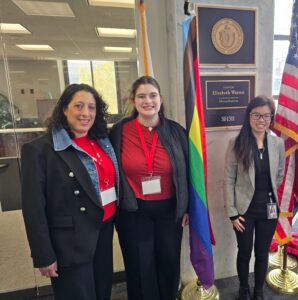
On the day of meetings, we dressed in red, the AHA’s signature color, so that we would be visible as we walked the streets and halls of the Capitol. We had productive meetings at the offices of Senator Warren, Senator Markey, Representative Auchincloss, and Representative Clark. They explained the difficulty of securing funding in today’s political climate while expressing their support for creating safer communities for their constituents. They were all shocked to learn that Massachusetts is one of only 9 states that do not currently require CPR and AED education in schools, meaning that our state could benefit a lot from this federal grant money.
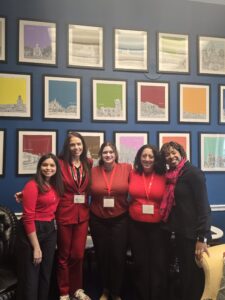
One highlight of my trip was spending time in Representative Clark’s spectacular office where the largest wall contains a bold, blue gallery-wall with separate prints representing each town in her district. Sitting beside the print from my town, I felt humbled to speak on behalf of not just myself but the rest of my community. Gathering for a group photo on the East Steps of the Capitol Building facing the Supreme Court is another special memory. With Miss America anchoring our delegation at the center, I took a moment to absorb that I was a part of such a powerful group of voices trying to encourage our government to take the steps necessary to make our schools and communities safer places.
I am grateful that the AHA has helped me learn how to use my voice to create the change we need. My hope is that our legislators take this opportunity to move us a step closer to being a Nation of Lifesavers by funding the HEARTS Act.