First Heart on the Hill
December, 4 2025
I stepped off the metro in Washington DC on Monday afternoon, ready to spend the next two days advocating on Capitol Hill for the American Heart Association. With a couple of free hours before training began, I explored the city. The Spy Museum sat directly across from my hotel, so I peeked inside before making my way to the WWII memorial. Standing there, looking out over the reflection pool toward the Washington Monument in the distance, I felt the weight of where I was and why I was there. I love DC. The history, the purpose, the sense that important things happen here. And I felt so incredibly lucky to be there on behalf of the American Heart Association.
When training started that evening back at the hotel, the mood shifted. The room filled with advocates, each carrying their own story. I listened as cardiac arrest survivors shared their experiences and heard from people who had lost loved ones because the right preparation wasn’t in place. What struck me most was how narrow the margin was between life and death. We’re talking about minutes, sometimes seconds. The difference came down to whether trained individuals were nearby, whether an AED was accessible. These weren’t abstract policy discussions anymore. These were real people whose lives had been forever changed by the presence or absence of CPR training and emergency equipment. I left that session inspired and ready to tell Rhode Island’s story and push for change.
And then I met my lobbying team. Mindy Beyer, a longtime volunteer from Maine who runs the largest Heart Attack Clinic in her state, shared her personal story. Lake Majestic, a Community Advocacy director, would help coordinate our congressional visits. The three of us sat down to briefly outline what we’d say the next day, making sure our messages would complement each other. Dinner that night was wonderful (five-star meal, no complaints here!), and I met even more amazing advocates.
Back in my hotel room, I rehearsed what I wanted to say. While most of my advocacy work had been in Massachusetts, I wanted to make sure I could speak powerfully about Rhode Island’s specific needs and opportunities. Cardiac arrest doesn’t respect state lines, after all.
I kept coming back to a few key points that I knew would resonate. Rhode Island graduates about 10,000 seniors from public high schools every year. Brown University Health, the state’s largest hospital system, employs 14,000 people. If we could teach CPR to every high school student, we’d essentially be putting a group of ready lifesavers the size of that entire hospital system into Rhode Island communities. Trained individuals would be on sports fields, in classrooms, at family gatherings, ready to act in those critical minutes when every second counts.
Rhode Island already has a CPR mandate, but here’s the problem: it’s unfunded. A 2022 study found that only 26% of schools actually teach it. The gap between policy and reality is enormous, and the reason is often straightforward: lack of funding. This matched exactly what I’ve seen in Massachusetts. Of the nearly 150 students I’ve worked with on CPR advocacy, the ones who struggle most to implement programs in their schools are those whose schools simply can’t afford it. Rhode Island serves as a perfect case study in why unfunded mandates don’t work. The HEARTS Act, which passed Congress but hasn’t received funding through either Senate or House appropriations, risks becoming another example of good intentions without the resources to back them up. When we don’t fund these programs, we leave schools with fewer resources behind, ultimately widening the survival gap from cardiac arrest between low and high income areas.
But I also wanted to drive home another point, something I tried to make abundantly clear with everyone I spoke to: as incredible as it is to save a life with CPR, it’s even better to prevent cardiac arrest in the first place. That means investing in research into cardiomyopathy and developing screening guidelines.
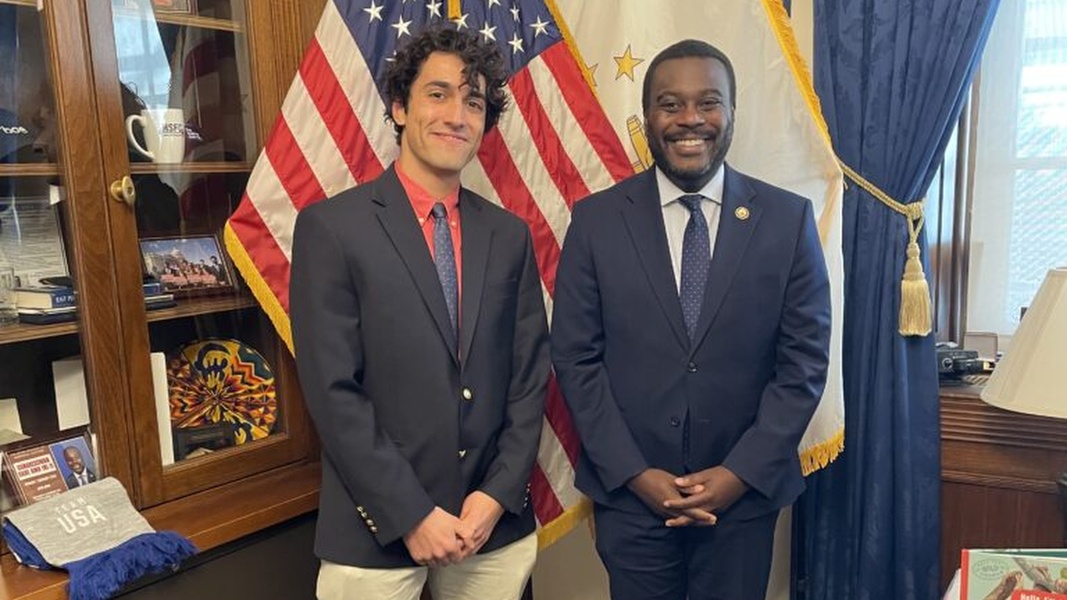
The next morning, we made our way through the Capitol, carrying these stories and statistics into congressional offices. Walking into Representative Gabriel Amo’s office, I felt the responsibility of representing not just my own advocacy but all the stories I’d heard the day before. Mindy shared her story, grounding everything in lived reality and showing exactly why the HEARTS Act needs funding, not just passage. Later in the day, meeting with staff from the offices of Senators Reed and Whitehouse, I was genuinely astonished by how beautiful the Senate building was, how each room had its own character and design. I loved pointing out little Rhode Island touches, things that felt close to my heart and connected to home. And can we talk about the business cards? The embossed golden eagle in the upper left corner was so cool.
The response to our advocacy was supportive across the board, though I won’t say it was overwhelmingly enthusiastic. The government was in the middle of a shutdown, so getting it reopened was understandably the primary focus. But still, in each meeting, I could feel us pushing the needle.
Over the past week, I’ve thought about those minutes that separate life from death. About the cardiac arrest survivors I’d met who were only alive because someone nearby knew CPR. About the families who’d lost loved ones when preparation fell short. About the students I’ve worked with who want to learn these skills but whose schools can’t afford to teach them. This work matters. Every meeting matters. Every story shared matters. And while Congress debates budgets and appropriations, real people are waiting for us to turn policy into action, to transform good intentions into funded programs that save lives.
My first time advocating in DC won’t be my last.
By Nayan Sapers