Advocate Spotlight: Erin Zabawa
May 28, 2026
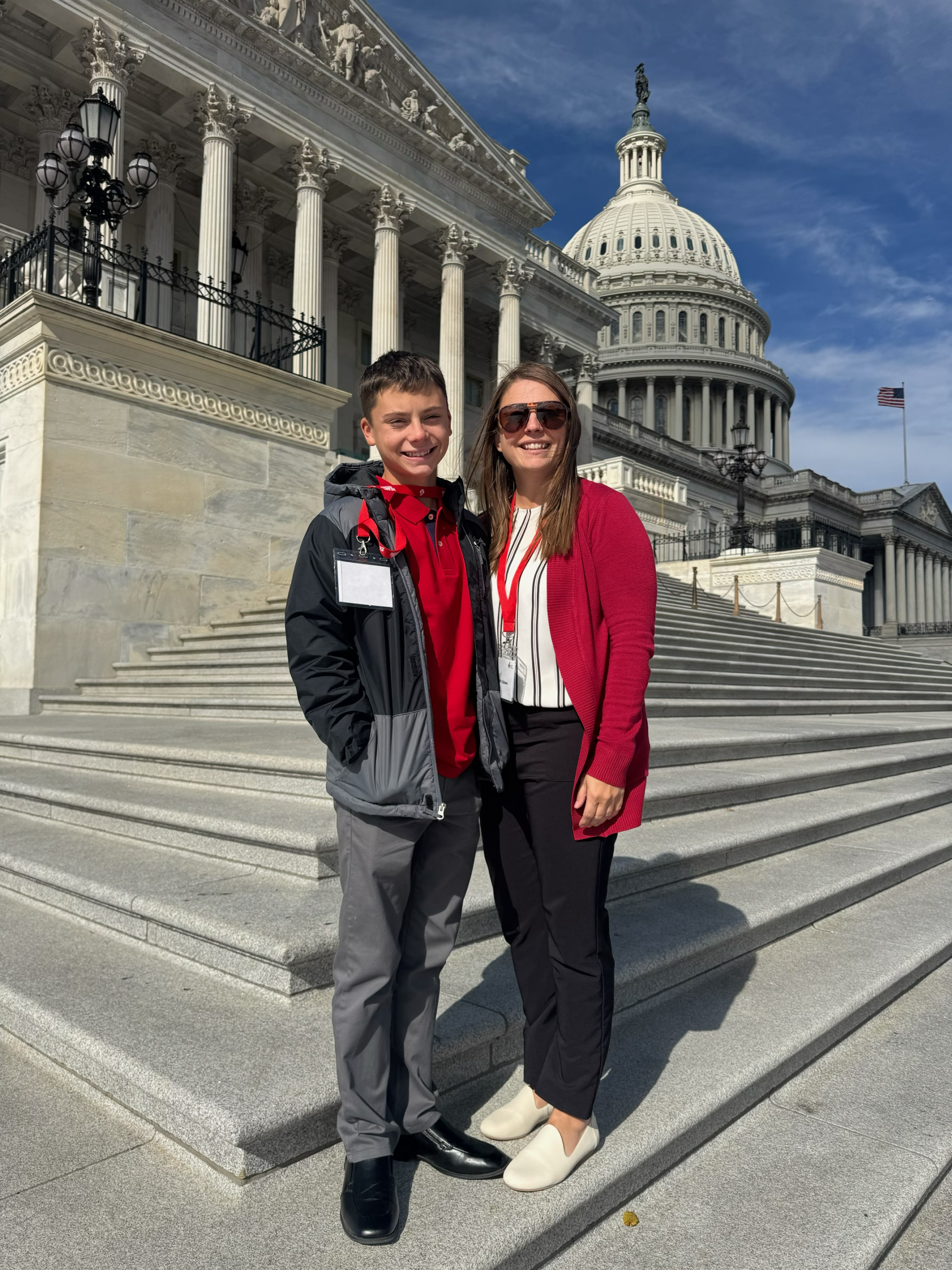
Above photo: In 2025, Erin and Memphis Zabawa flew to Washington, D.C. to tell their story and urge elected officials to fund the HEARTS Act.
A teacher, a mom and a moment that changed everything
Fifth grade teacher Erin Zabawa still finds it hard to talk about CPR in schools without getting emotional. Not because she teaches it – but because one day, it saved her own child’s life.
Erin had never personally known a child who needed CPR. Then, on an ordinary Friday morning, it became her family’s story.
Her 13-year-old son, Memphis, was a seventh grader getting ready for school and a cross-country meet later that afternoon. As Erin dropped him off, she reminded him she wouldn’t be able to make it to the race because of work. He seemed fine with it, though she felt a small tug of guilt – one lots of parents recognize. She promised herself she’d catch the next one.
A few hours later, the phone rang.
It was her husband, Justin. His voice was shaking. He told her to get in the car and go straight to the children’s hospital. Memphis had collapsed during his run. He was in an ambulance.
In that moment, Erin didn’t have answers – just fear. She drove, praying and trying to prepare herself for the unknown.
When she pulled up to the hospital, she saw her son being rushed in on a gurney. She followed closely, her heart racing. He wouldn’t wake up for another 16 hours. When he finally did, he told her he’d had trouble breathing during the run.
EMS shared what Erin hadn’t realized: Memphis’ heart had stopped. And then it had to be restarted.
His life was saved because someone nearby at the cross-country meet knew CPR. Someone else knew where to find an automated external defibrillator (AED).
For days, Erin didn’t know who those people were. The mystery weighed on her. She felt overwhelming gratitude – and a need to say thank you.
She turned to social media and shared her family’s story.
“My child almost died,” she wrote. “And if somebody out there hadn’t decided to save his life, he would have. I need you to help me figure out who saved Memphis’.”
The responses came quickly.
A mom and teacher who was in attendance at the meet to support her own child noticed Memphis because something about him just didn’t look right.
She stayed aware. When he collapsed, she stepped in and began CPR. An ER nurse nearby helped. The cross-country coach retrieved an AED. Emergency responders arrived within minutes.
Looking back, Erin calls the first responders, the bystanders who jumped into action before EMS could arrive, “angels on earth.”
“They made sure Memphis would live to run again,” she says.
What surprised Erin just as much as their actions was their reaction afterward. They didn’t want recognition. They didn’t see themselves as heroes. They were simply glad Memphis was okay.
That’s when another realization surfaced: Real heroes often don’t ask for credit.
Erin still wanted to express her thanks. She just needed to find a new way.
She began to see a bigger picture – one shaped by preparation, access and everyday people willing to help. Memphis survived because trained bystanders were present. Because an AED was nearby. Because there was a plan.
That understanding gave Erin a new sense of purpose.
Rather than spotlight a single moment, she began speaking up for all the moments that happen before an emergency – the training, the planning, the quiet readiness that can change an outcome.
She became an American Heart Association Heart Powered advocate, sharing her family’s story with honesty and heart. Over time, she found her voice. Erin and Memphis traveled to Washington, D.C., where they spoke with their Nebraska members of Congress about the importance of CPR and AED access in schools.
They talked about Memphis. About preparation. About possibility.
Their advocacy supported momentum for the bipartisan HEARTS Act, signed into law in 2024, which helps schools prepare for cardiac emergencies. For Erin, passing the law mattered – but fully funding it matters just as much.
Today, Erin still wishes she could thank the people who saved her son in a way that truly matches what they gave her family. But she believes this work is one way of paying it forward.
Her life, like Memphis’, has taken on new meaning. And her message is simple: When people are prepared, when tools are within reach and when someone feels empowered to act – lives can continue. Moments can be reclaimed. And families can keep moving forward together.
To learn more about the American Heart Association’s Heart Powered movement, text HEART to 46839 or visit HeartPowered.org.
In 2025, Erin and Memphis Zabawa flew to Washington, D.C. to tell their story and urge elected officials to fund the HEARTS Act.

From left, Memphis, Justin, Erin and Cruz Zabawa will tell anyone who will listen about the importance of being the first responder until help arrives. Their tight-knit family was almost reduced to three the day heroic bystanders saved Memphis during a cardiac emergency in 2024.